


In order to fully explore the invisible connections between people, society, things, and the world, we will first examine the most important areas addressed in this series.
Things
Defining the concept of a thing may seem straightforward at first, but upon closer analysis, we find that the meaning of the term depends on the perspective from which we approach the issue. While in many cultures, qualities that transcend material existence are ascribed to elements of both living and inanimate nature—including celestial bodies,1 in other parts of the world, plants and animals (as was the case in Slovakia until 2018)2 and even humans are treated as things. Through dehumanisation, objectification, commodification, or sexualisation, they are treated as objects, animals, goods, or tools of labour.3
Life
NASA defines life as “…a self-sustaining chemical system capable of Darwinian evolution”.4 Until recently, scientists believed that the oldest known forms of life—microorganisms and traces of their activity preserved in the form of stromatolites—emerged approximately 3.5 to 2.5 billion years ago.5 However, new research suggests that life may have emerged much earlier.6 Our planet is approximately 4.6 billion years old,7 and according to recent studies, the first signs of life may have appeared as early as 3.75 billion years ago.8 It is possible that future discoveries will date the origin of life even further back.
But how can we distinguish living organisms from non-living matter? Organisms share several common characteristics that enable us to identify them: they are capable of obtaining energy from their environment, responding to changes in it, growing, reproducing, and undergoing differentiation.9 The nature of organic life is chemical—metabolism takes place within organisms, genetic information is transmitted through molecules, and chemical transformations are governed by thermodynamic processes.10 Living organisms contain no elements other than those found in the non-living world, nor do they undergo chemical reactions that differ from those occurring in non-living matter.11
Souls and Spirits
Modern humans evolved approximately 200,000 years ago and have been interconnected with nature ever since, which provides the conditions for their existence. In their attempts to explain the phenomena occurring in the natural world, humans developed spiritual concepts that anthropology later identified as animism, animatism, magic, fetishism, and totemism.12 In these systems, souls and spirits are regarded as the only truly real beings. External vessels—the physical bodies of humans, animals, as well as plants and objects—serve merely as temporary dwellings for them.13
According to the French sociologist Émile Durkheim (1858–1917),14 the distinction between the spirit and the soul in these spiritual concepts lies in the manner of their connection to the physical vessel. The soul can leave it only in exceptional circumstances, whereas the spirit is free to depart and exist independently of it. Contact with the spirit is possible only through ritual practices.15
Animism
Animism is a form of religious thought. Its essence lies in the belief that souls are the principle of both life and thought, and that they are attributed not only to individual elements of the living world, but also to the non-living world, including the universe.16
According to Andrey Safronov,17 the development of animism can be divided into three stages. In the first of them, immaterial components were attributed to objects; in the second, these components were considered separate from matter (this stage forms the basis for the emergence of religions); and in the third stage, theories emerged concerning the existence of entities independent of material substance.18
Contemporary animism, also known as new animism, has returned to scientific discourse after many years. It can be characterised as an ontology focusing on the relationship between humans and the world. New animism is environmentally oriented – its aim is to bridge the divide between humans and nature and to contribute to greater societal awareness of environmental threats. In light of the ongoing climate crisis, it is more relevant than ever before.19, 20
Animatism
In connection with animism, the term animatism is also mentioned in anthropology. In his work Totem and Taboo, the psychiatrist, neurologist, and founder of psychoanalysis Sigmund Freud (1856–1939)21 drew attention to it as a theory concerned with the animation of that part of nature which appears to be lifeless. Freud drew on the work of the English social anthropologist Robert R. Marett (1866–1943), who developed the concept of animatism as a pre-animistic stage of spiritual thought.22
The difference between animism and animatism lies in the fact that, whilst animism could be characterised as a belief in the existence of spirits inhabiting objects in nature, animatism represents a belief in a supernatural and omnipresent force which is not personified – it lacks personality.23
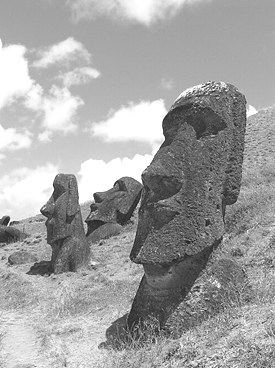
This force is known as mana (a term originating in Oceania).24 According to ancient legends, people also possess mana, and when they unite, they can merge their individual mana into a single, immense force – this is said to be how the moai statues on Easter Island were erected (Fig. 1). The members of the entire tribe transferred their mana to the chief, who was then believed to possess sufficient strength to raise the monumental statues.25
Fig. 1: Unknown artists of the Rapa Nui culture, Easter Island, Moai, c. 1000–1600 CE, stone
Source: Aurbina / Wikimedia Commons (Public Domain)
Fetishism
When this power entered an object, it became a fetish. Mana had the ability to pass from one object to another, thereby increasing its value.26 According to Safronov, the first stage in the development of animism – characterised by the attribution of an immaterial element to matter – was preceded by fetishism, in which objects were believed to influence their surroundings through the power contained within them.27 A fetish can be any object, often chosen from among randomly discovered items preserved due to a sense of fascination. However, for an object to be considered a fetish, there must be a belief that it contains supernatural power, or it must be treated as a conscious being.28
Magic
Magic is an activity in the form of rituals and spells performed with the aim of influencing various areas of life to one’s advantage.29 Humanity has encountered it throughout its existence. The earliest magical rituals were aimed at ensuring a sufficient supply of food30 and they apparently included some of the earliest forms of artistic expression – numerous prehistoric cave paintings, drawings, and engravings are interpreted as part of magical practices. Magic is closely linked to animism – prehistoric people communicated with the whole of nature, which they perceived as alive. This approach can still be observed today among traditional communities that continue to live in close relationship with nature.31
Totemism
Totemism is one of the oldest cultural institutions.32 It is both a religious and a social system,33 whose fundamental religious philosophy is animism. The totem plays a key role; members of the tribe regard it as their ancestor and rely on its protection. Totemism is characterised by a sense of belonging and a spiritual connection with nature. It arose as a response to fears of omnipresent danger.34 The word totem originates from the Ojibwe language, from which it entered English through the work of anthropologists and later spread into other languages.35
Shamanism
Shamanism is one of the most widespread religious practices; however, it is not a religion in itself, but rather the performance of practices associated with various religious systems. The role of the shaman is to establish a connection between the physical world and the spirit world, serving not only people but also spirits. A person who has been initiated or possesses shamanic abilities can become a shaman. A shaman is a spiritual practitioner believed to possess magical powers that enable them to heal, search for missing persons, predict the future, cast spells, or remove them.36, 37 According to Safronov, shamanism represents the pinnacle of prehistoric culture due to its absorption of all forms of proto-religion, as well as its proximity to theories of developed animism.38
Consciousness and the Unconscious
According to the Slovak biochemist and educator Professor Ladislav Kováč (1932),39 one of the characteristics of consciousness is the creation of conditions for formulating goals aimed at eliminating pain and maximising pleasurable sensations. Consciousness enables daydreaming, which can serve as a means of self-strengthening, self-deceptive justification, and the search for ways to avoid unpleasant experiences.40
The Swiss neurologist, psychiatrist, and psychotherapist Carl Gustav Jung (1875–1961)41 was convinced that consciousness, together with the personal and collective unconscious, forms part of a system known as the psyche. In his theories, similarly to Sigmund Freud’s concepts, consciousness is associated with the function of the Ego, which filters contents with the aim of preventing disruption to one’s sense of personal integrity. Undesirable information is stored in the unconscious.42, 43 The unconscious does not communicate directly; instead, it establishes a connection through symbols. In addition to dreams, it also interacts with consciousness through imagination, which manifests itself, for example, during creative work or daydreaming.44
Jung chose the term archetypes to describe the unconscious structures of the psyche that have a generalising character. These represent combinations of psychological models and systems operating within the unconscious. Archetypes, in the form of symbols, are present in every human being and exist in an unlimited number of variations and combinations. This diversity is the source of the uniqueness of the individual psyche. The conscious and the unconscious form a single whole; therefore, it is the individual’s task to become familiar with their unconscious and to bring the information contained within it into consciousness. Jung called this process individuation. Its outcome is the attainment of wholeness.45, 46, 47
The creation of symbols is inherent to the unconscious, and their interpretation is the key to understanding it. They form the basis of philosophy, religion, and art, and our consciousness has also emerged from them.48 Archetypes, too, are symbolic and, according to Jung, manifest themselves through metaphors.49 Anything can possess symbolic meaning: natural and human-made objects, abstract forms, or the entire universe. The mind produces symbols unconsciously.50
Myths are also closely linked to the unconscious.51 The German psychologist and physiologist Wilhelm Wundt (1832–1920)52 discovered that animistic beliefs from different periods and regions of the world resemble one another, even in the absence of any contact. He therefore concluded that they are products of the psyche, which possesses a myth-making character.53
Although research into human consciousness and the unconscious has advanced significantly, we still do not have all the answers. This also applies to research into the consciousness of animals and plants. However, many new studies are changing the established view, which had significantly underestimated them in this respect. For example, the European Food Safety Authority (EFSA) has produced a comprehensive scientific report stating that animals perceive, possess consciousness, and are capable of experiencing pain. The report recommends that they be treated with due consideration of these facts.54, 55
Some scientists hypothesise that a certain form of consciousness may also be present in lower forms of life. For example, according to the authors of the study Plants, Climate and People: Plant Intelligence Changes Everything – the Slovak biologist specialising in plant neurobiology, Professor František Baluška (1957),56 and the Italian botanist Professor Stefano Mancuso (1965)57 – plants are capable of communicating with one another, and able to respond to threats. The scientists further suggest that plants may respond more appropriately than humans in the context of the climate crisis.58
References
1. TYLOR, E. B., Primitive Culture, 1888.
2. Od 1. septembra zviera už nie je vec, 2018. [online]. [accessed 2024–11–15]. Available at: https://www.mpsr.sk/aktualne/od-1-septembra-zviera-uz-nie-je-vec/13332/
3. See BEAMAN, L., GURUNG, R., Examining Objectification and Dehumanization: The Effects of Race and Sexualization, 2024.
4. In the original: Life is a self-sustaining chemical system capable of Darwinian evolution. Translation: Zuzana Dolinay. In About Life Detection. [online]. [accessed 2025–04–11]. Available at: https://astrobiology.nasa.gov/research/life-detection/about/
5. PANČÍK, P., Pôvod života, 2020. [online]. [accessed 2024–09–25]. Available at: https://biopedia.sk/evolucia/povod-zivota
6. GREAVES, M., Diverse life forms may have evolved earlier than previously thought, 2022. [online]. [accessed 2024–12–18]. Available at: https://www.ucl.ac.uk/news/2022/apr/diverse-life-forms-may-have-evolved-earlier-previously-thought
7. PANČÍK, P., Pôvod života, 2020. [online]. [accessed 2024–09–25]. Available at: https://biopedia.sk/evolucia/povod-zivota
8. Researchers analysed a 3.75 to 4.28 billion-year-old rock and discovered traces of bacteria. In GREAVES, M., Diverse life forms may have evolved earlier than previously thought, 2022. [online]. [accessed 2024–12–18]. Available at: https://www.ucl.ac.uk/news/2022/apr/diverse-life-forms-may-have-evolved-earlier-previously-thought
9. Not all living organisms necessarily meet each of these characteristics. In PANČÍK, P., Pôvod života, 2020. [online]. [accessed 2024–09–25]. Available at: https://biopedia.sk/evolucia/povod-zivota
10. About Life Detection. [online]. [accessed 2025–04–11]. Available at: https://astrobiology.nasa.gov/research/life-detection/about/
11. PANČÍK, P., Pôvod života, 2020. [online]. [accessed 2024–09–25]. Available at: https://biopedia.sk/evolucia/povod-zivota
12. VARGA, R., K problematike riešenia vzťahov človeka k prírode v historickej reflexii, 2013, p. 259.
13. KANDERT, J., Religious Systems: Religious Man and How to Understand Him, 2010, pp. 23–24.
14. Émile Durkheim. [online]. [accessed 2025–01–08]. Available at: https://www.britannica.com/biography/Emile-Durkheim
15. DURKHEIM, E., The Elementary Forms of the Religious Life, 1915, pp. 51–52.
16. Animizmus. [online]. [accessed 2024–11–16]. Available at: https://dai.fmph.uniba.sk/~filit/fva/animizmus.html
17. Andrey Safronov. [online]. [accessed 2024–12–16]. Available at: https://independent.academia.edu/Asafronov
18. SAFRONOV, A. G., Psychological Practices in Mystic Traditions: From Archaic to Our Days, 2011, p. 111.
19. HELANDER-RENVALL, E., Animism, Personhood and the Nature of Reality: Sami Perspectives, 2010. [online]. [accessed 2024–12–18]. Available at: https://www.cambridge.org/core/journals/polar-record/article/abs/animism-personhood-and-the-nature-of-reality-sami-perspectives/099876A474101E4434388ED48D634A44
20. WILKINSON, D. A., Is There Such a Thing as Animism?, 2017, pp. 289–292.
21. Sigmund Freud. [online]. [accessed 2024–12–17]. Available at: https://biografia.sk/sigmund-freud/
22. FREUD, S., Totem and Taboo: Resemblances between the Psychic Lives of Savages and Neurotics, 1919, pp. 38–39.
23. Difference Between Animism and Animatism, 2016. [online]. [accessed 2024–11–23]. Available at: https://www.differencebetween.com/difference-between-animism-and-vs-animatism/#google_vignette
24. TITARENKO, V. V., The Phenomenon of Charisma: Social and Psychological Aspects, 1999. In SAFRONOV, A. G., Psychological Practices in Mystic Traditions: From Archaic to Our Days, 2011, p. 113.
25. SAFRONOV, A. G., Psychological Practices in Mystic Traditions: From Archaic to Our Days, 2011, p. 113.
26. Ibid., p. 113.
27. Ibid., p. 111.
28. TYLOR, E. B., Primitive Culture: Vol. II: Researches into the Development of Mythology, Philosophy, Religion, Language, Art, and Custom, 1920, pp. 144–145.
29. MALINOWSKI, B., Magic, Science and Religion and Other Essays, 1948, p. 56.
30. BELKO, D., Vývoj záujmu o mágiu, 1997, p. 295.
31. Ibid., p. 295.
32. SKAČAN, J., Ivan Dubnička : Šamani, mesiáši, proroci a reformátori, 2013. [online]. [accessed 2024–12–19]. Available at: https://philosophicacritica.ukf.sk/uploads/1/3/9/8/13980582/recenzia_skacan.pdf, p. 86.
33. FREUD, S., Totem and Taboo: Resemblances between the Psychic Lives of Savages and Neurotics, 1919, p. 50.
34. NIKULIN, A., Pohanstvo vo svetle kresťanskej reflexie duchovného života, 2019, pp. 218–219.
35. TYLOR, E. B., Primitive Culture: Vol. II: Researches into the Development of Mythology, Philosophy, Religion, Language, Art, and Custom, 1920, pp. 234–235.
36. NIKULIN, A., Pohanstvo vo svetle kresťanskej reflexie duchovného života, 2019, p. 219.
37. BURDA, F., Úvod do kulturní a sociální antropologie, [no date], p. 78.
38. SAFRONOV, A. G., Psychological Practices in Mystic Traditions: From Archaic to Our Days, 2011, p. 126.
39. Kováč, Ladislav. [online]. [accessed 2024–12–17]. Available at: https://beliana.sav.sk/heslo/kovac-ladislav
40. KOVÁČ, L., Ľudské vedomie je produktom evolučnej eskalácie emocionálneho výberu, 2003. In KELEMEN, J. (ed.), Kognice a umělý život III, 2003, p. 16.
41. Carl Jung. [online]. [accessed 2024–12–17]. Available at: https://www.britannica.com/biography/Carl-Jung
42. PAUER, J., Je ešte možný spoločný svet? : Alebo o jednote v mnohosti a o spoločnom základe v potencii, 2003, p. 95.
43. HŮLOVÁ, S., Využití práce s osobním a kolektivním nevědomím, 2017, p. 5.
44. JOHNSON, R. A., Sny jako řeč nevědomí, 2020, p. 11.
45. JOHNSON, R. A., Sny jako řeč nevědomí, 2020, p. 19.
46. CHRZ, V., Člověk a jeho symboly : Recenze, 2018, p. 526.
47. VON FRANZ, M. L., The Process of Individuation, 1964. In JUNG, C. G., VON FRANZ, M. L. (eds.), Man and His Symbols, 1964, pp. 160–161.
48. JOHNSON, R. A., Sny jako řeč nevědomí, 2020, p. 28.
49. Ibid., p. 28.
50. JAFFÉ, A., Symbolism in the Visual Arts, 1964. In JUNG, C. G., VON FRANZ, M. L. (eds.), Man and His Symbols, 1964, p. 232.
51. FREUD, S., Totem and Taboo: Resemblances between the Psychic Lives of Savages and Neurotics, 1969, p. 39.
52. Wilhelm Wundt. [online]. [accessed 2025–01–08]. Available at: https://www.britannica.com/biography/Wilhelm-Wundt
53. WUNDT, W. In FREUD, S., Totem and Taboo: Resemblances between the Psychic Lives of Savages and Neurotics, 1919, p. 39.
54. Animal Consciousness, 2016. [online]. [accessed 2024–10–18]. Available at: https://www.efsa.europa.eu/en/supporting/pub/en-1196
55. Vedecká správa úradu EFSA o vedomí zvierat, 2017. [online]. [accessed 2024–10–18]. Available at: https://www.mpsr.sk/vedecka-sprava-uradu-efsa-o-vedomi-zvierat/753-40-753-11468/
56. Prof. RNDr. František Baluška, Ph.D. [online]. [accessed 2024–12–17]. Available at: https://is.cuni.cz/webapps/whois2/osoba/1613448318147512/?lang=cs
57. Stefano Mancuso. [online]. [accessed 2024–12–17]. Available at: https://scholar.google.com/citations?user=l3wMLRoAAAAJ&hl=en
58. BALUŠKA, F., MANCUSO, S., Plants, Climate and Humans: Plant Intelligence Changes Everything, 2020.
The complete bibliographic references for these sources can be found here.