


As already mentioned in the introductory article, people have presumably been trying to understand what makes us alive since prehistoric times. However, it was not until antiquity that these reflections began to take clearer shape.
Ancient Greek thinkers were already reflecting on the soul as early as the 6th century BC, during the mythical-religious period. They regarded it as a gift from the gods and therefore considered it capable of transcending the material world. According to them, the soul was imprisoned in the body.[1]
Greek philosophers of the pre-classical period understood the human being in dualistic terms – as composed of body and soul (they referred to the body as soma and the soul as psyché) – and examined these two components, as well as the relationship between them, from various perspectives.[2] The philosopher Democritus of Abdera (c. 460–370 BC)[3] likened the human being to a mosaic composed of particles – atoms – of body and soul and regarded the soul as one of the parts of the body.[4]
However, the Greeks did not use the word psyché solely to refer to the soul. The term was initially used to denote the principle of life but also the daemon entering the organism, which, upon its death, moves on to another physical vessel. The psyché was not bound to a single body – it could be present in various bodies and even exist outside them.[5]
The Greek philosopher Socrates (c. 470–399 BC)[6] regarded the soul as the essence of the person, the most important component of a human being, an immortal divine element, and the ruler of the body, which must be cared for.[7], [8] According to him, it was the soul that had the capacity to make people good; however, this was conditional upon striving to understand the nature of goodness itself, as well as upon the individual coming to desire to become a better person of their own accord.[9] Socrates associated goodness and virtue with reason, and the decline of morals, conversely, with ignorance. In his reflections, he also considered the inner voice, which he called the daimonion. Based on knowledge, this was meant to guide the human soul to do good and thus be in harmony with its divine nature. It can be likened to conscience.[10], [11]
The Greek philosopher, mathematician and teacher Plato (428/427–348/347 BC)[12] likewise attributed a divine origin to the soul. According to him, the body is, on the one hand, a prison for the soul; on the other hand, however, it is essential, through the senses, for understanding the nature of eternal ideas. The soul governs bodily movements and, due to its otherworldly nature, is not internally connected to the material body, but only externally.[13] According to one of his theories, the soul has three parts: the rational part, governed by wisdom; the spirited part, governed by courage; and the appetitive part, governed by temperance. Justice is responsible for overseeing the relationships between them. According to him, there is only one virtue, the essence of which is truth, although it has various names.[14], [15] According to Radek Chlup (1972), a scholar of religious studies at the Institute of Philosophy and Religious Studies, Faculty of Arts, Charles University,[16] Plato transformed what was originally a marginal intellectual current concerned with the dualism of soul and body and acknowledging a certain degree of autonomy for the soul, but which had not entered the general consciousness, into a doctrine of great significance and influence.[17]
Plato argued that souls are immortal, immaterial and simple – they constitute a single whole that has no parts. By virtue of this property, they do not cease to exist and, unlike the mortal body, are not subject to decay – after the body’s demise, they continue to exist in the immaterial realm, which he called the world of ideas.[18] These reflections on the soul were later incorporated into Christian philosophy.[19]
The Greek philosopher Aristotle (384–322 BC) also studied the soul.[20] He was interested in its nature, properties and relationship to the body,[21] to which it provides form (an important concept denoting the principle of life).[22], [23] According to him, the soul does not have a divine nature and ceases to exist along with the body. These two components form a unity, and the human being, composed of them, exists between two worlds – the material and the immaterial.[24] Nevertheless, he believed that human beings also possess a supernatural aspect, and he regarded the spirit of humanity as a whole as eternal.[25]
Aristotle distinguished between three components of the soul – rational (intellectual), sensory (sensitive), and vegetative. According to him, humans possess all three components, animals possess two, and plants possess only one.[26]
Source: ArchaiOptix / Wikimedia Commons (CC BY-SA 4.0)
According to the Greek philosopher Plotinus (203–269)[27] there exists a soul hypostasis, from which the world-soul originates. Its nature is the same as that of human souls, but it possesses more perfect faculties, and its role is to create and govern the world, which comprises both animate and inanimate nature, including the universe. The World Soul also creates plants and animals, which come into being when their seeds penetrate matter. They are created complete with their faculties – in the case of plants, Plotinus mentions the vegetative faculty, to which the faculty of sensation is added in animals.[28]
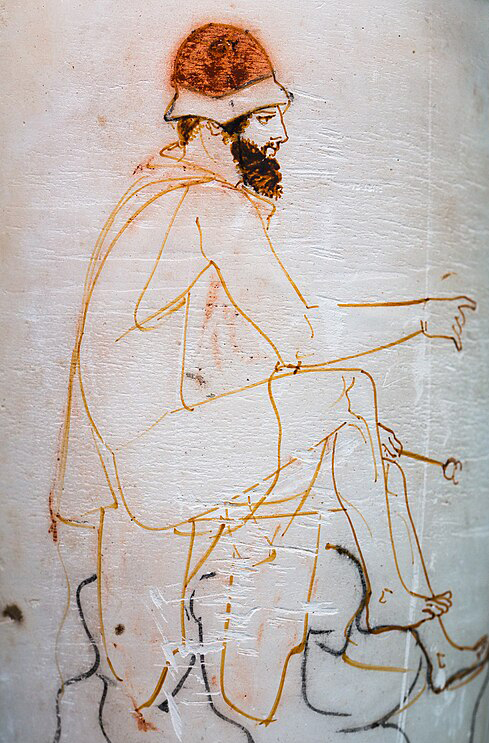
The Greeks believed that the god Hermes, also known as Psychopompos, guided souls to the underworld. A linear drawing on a lekythos-shaped vase (Fig. 1), used for storing oil and later also as part of funeral rites,[29] depicts him at the moment of preparing to guide the soul of a woman, represented as a shadow. The seated figure holds a herald’s staff, the kerykeion – a symbol of the messengers of the gods. The drawing is anatomically well executed, rendered in shades of ochre, brick red and dark brown, and assured brushstrokes reveal the hand of an experienced master.[30], [31]
According to the eminent French medievalist Jean-Claude Schmitt (1946)[32] scholars in the Middle Ages explored the relationship between the body (corpus, sarx) and the soul (anima), which they regarded as components of the personality, central to the psychophysiological tradition characteristic of the entire period. The concept of the spirit also began to emerge and was examined in relation to these two components, though it appeared relatively rarely. Philosophers of this period viewed the soul and the body in dichotomous terms; they were reluctant to separate them and believed that the soul animates the body.[33] The old dualistic understanding of body and soul as opposing entities gradually faded away and was replaced by an approach more compatible with Christian ideology, in which the soul is superior to the body – the latter being regarded as passive and dark. After death, the soul leaves the material body, which is doomed to decay. It is destined for salvation, with the promise of resurrection, which will reunite it with the body and reverse its decay.[34]
Source: Web umenia / Creative Commons – public domain
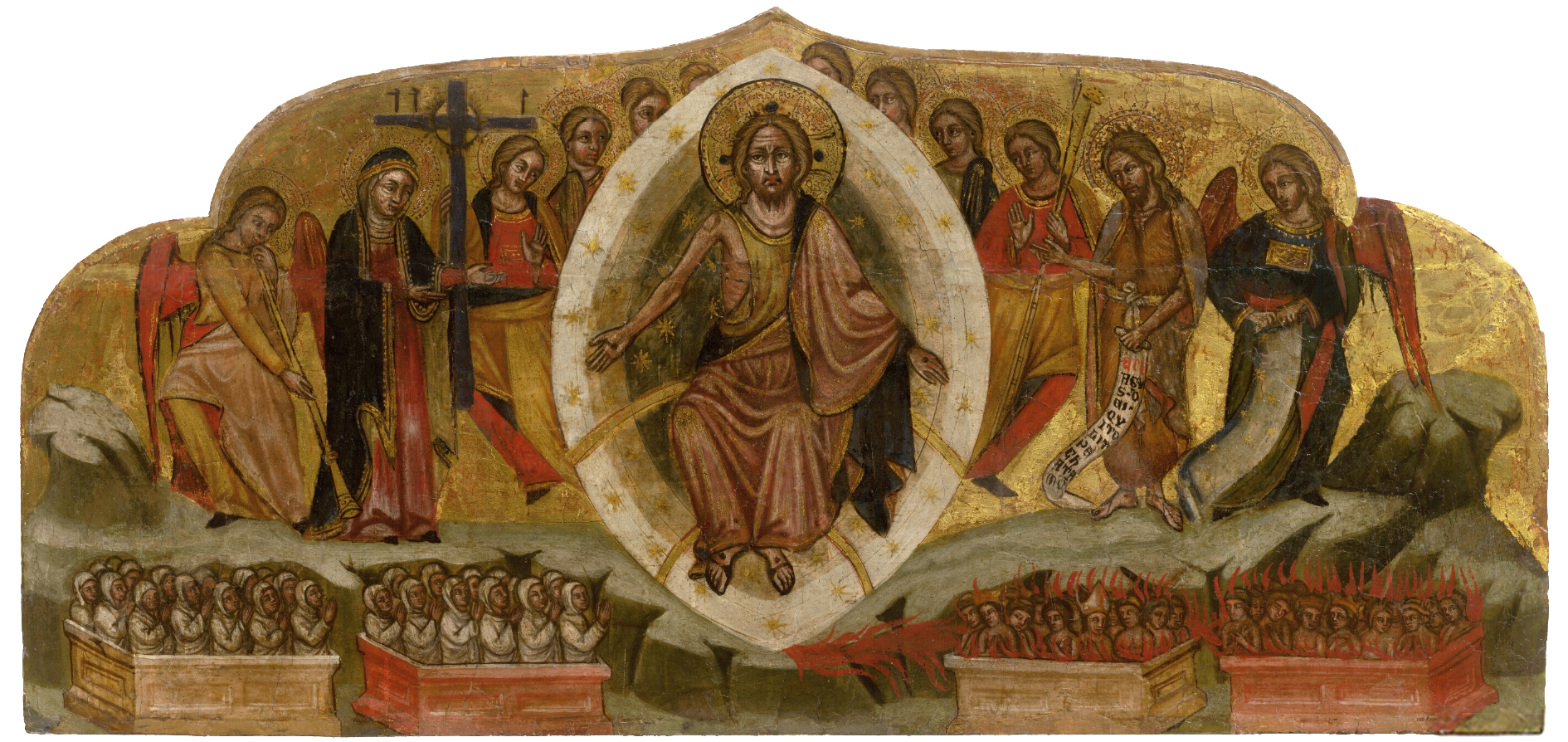
An example of mediaeval painting is the work Il Giudizio Universale (*The Last Judgement*) by the Italian painter Simone dei Crocifissi (1330–1399)[35] (Fig. 2), which depicts Christ in a mandorla in the role of judge, angels with the instruments with which he was tortured, and three groups of souls – the saved, those awaiting judgement, and the damned – burning in the flames of hell. The work forms part of the SNG collection.[36]
In the Bible, the concept of the soul is also attributed to animals. In Genezis, there is a reference to the command for the earth to bring forth all living souls, according to their respective kinds. In this context, domestic and wild animals are mentioned, as well as creatures that move.[37]
During the Renaissance, discourse on the soul and its immortality centred on three areas: metaphysics, epistemology and theology. Metaphysics sought to confirm or refute the existence of a human soul distinct from the souls of animals, one capable of surviving the demise of the physical body. From an epistemological perspective, the discussion centred on questions such as whether the very concept of the soul is merely an illusion, whether it resides in the same place as the mind, and whether it too is eternal.[38] During this period, within theological circles influenced by humanism, movements for spiritual renewal, a return to ancient ideals (particularly Plato’s teachings), and also in reaction to the Reformation, calls were heard for a shift towards greater unity not only between theology and metaphysics, but also between God’s will and reason, which had previously been separated and set in opposition to one another.[39]
Source: Factum Foundation / Wikimedia Commons (Public Domain)
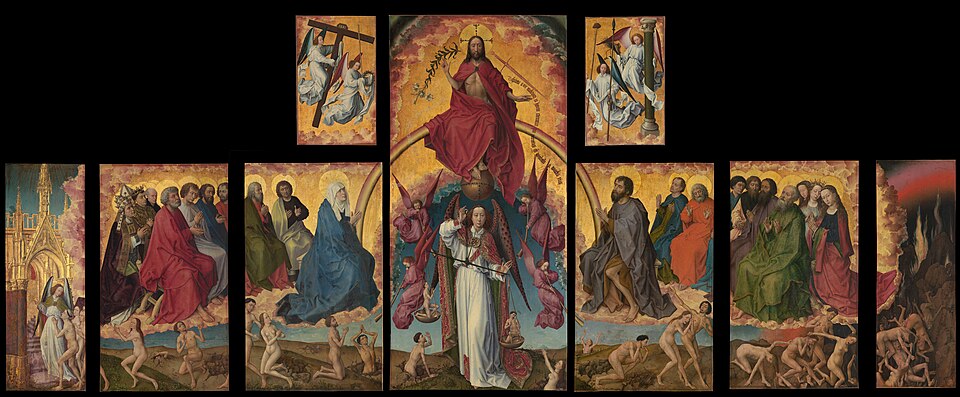
The theme of the Last Judgment was also explored by the Flemish painter and draughtsman Rogier van der Weyden (1399/1400–1464),[40] the creator of the polyptych Das Jüngste Gericht (The Last Judgment), also known as the Beaune Altarpiece (Fig. 3), created between 1443 and 1451 and comprising 15 paintings on 9 panels, 6 of which are double-sided. The central panel depicts Jesus seated on a rainbow and the Archangel Michael weighing souls.[41] The same theme was also masterfully rendered by the Italian sculptor, painter and architect Michelangelo Buonarroti (1475–1564).[42] In his world-famous fresco in the Sistine Chapel, entitled Il Giudizio universale (The Last Judgment), which he created between 1536 and 1541 (Figs. 4, 5), he depicted the Second Coming of Jesus Christ, including the Archangel Michael holding a book of souls recording the sins of every person.[43]
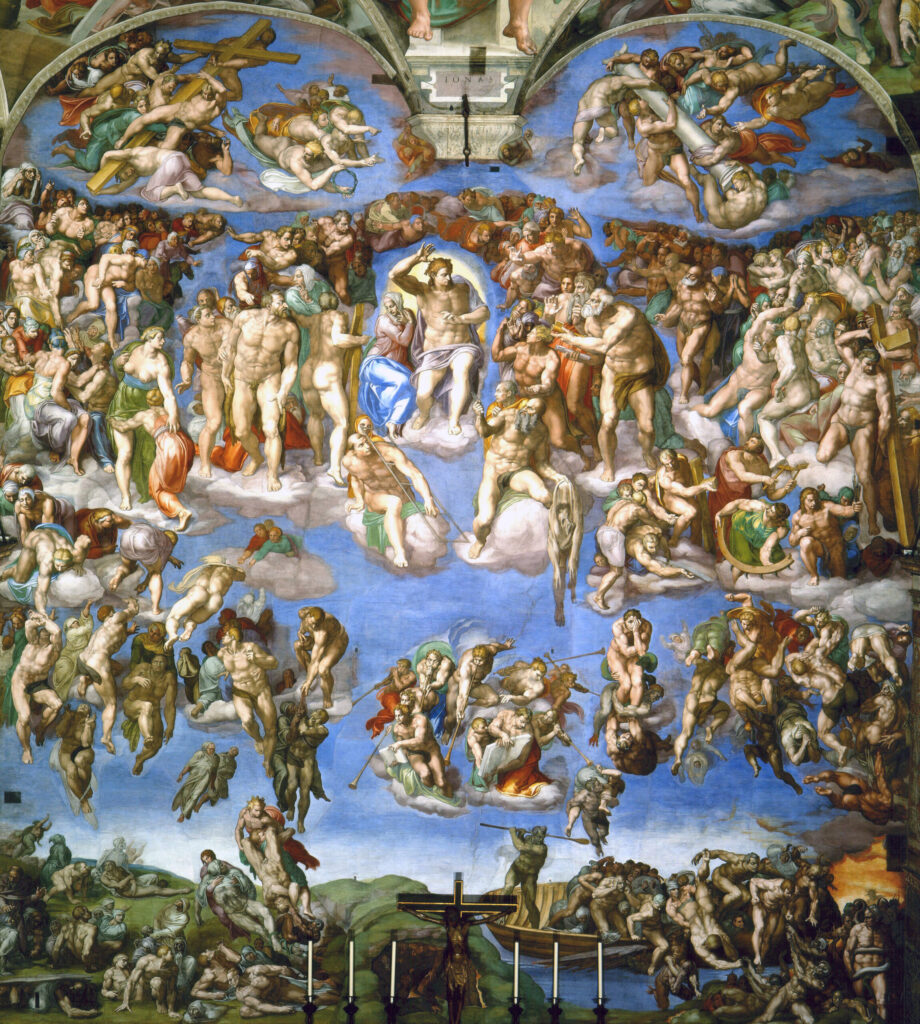
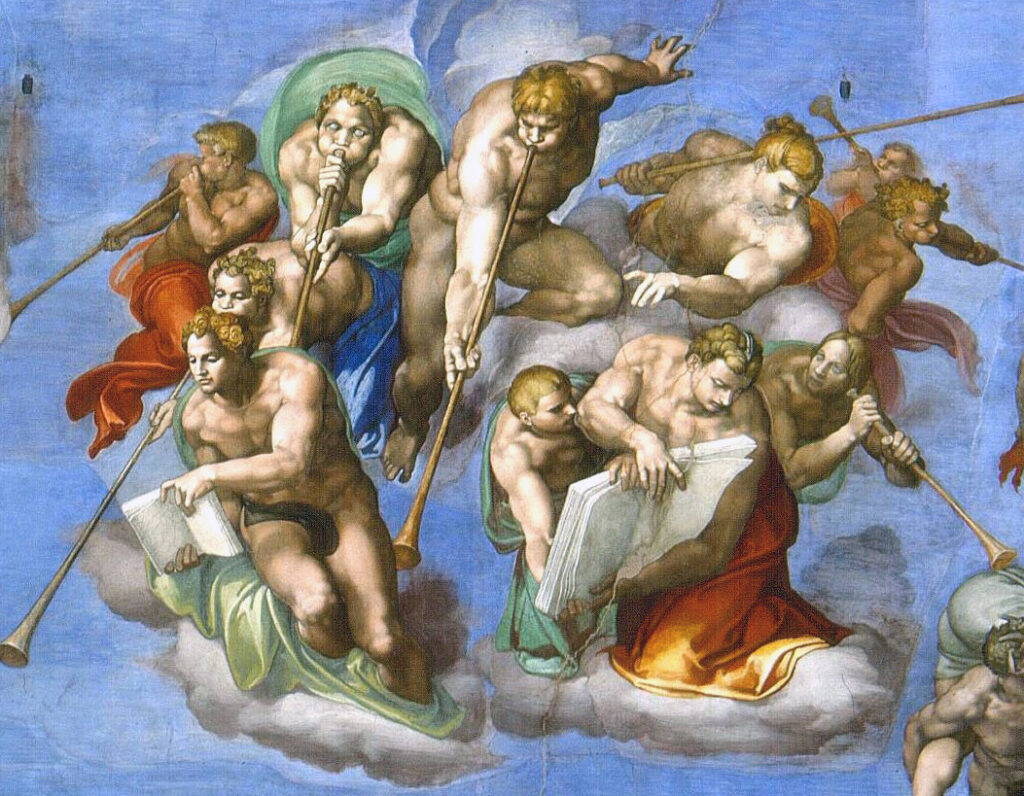
Source: Wikimedia Commons (Public Domain)
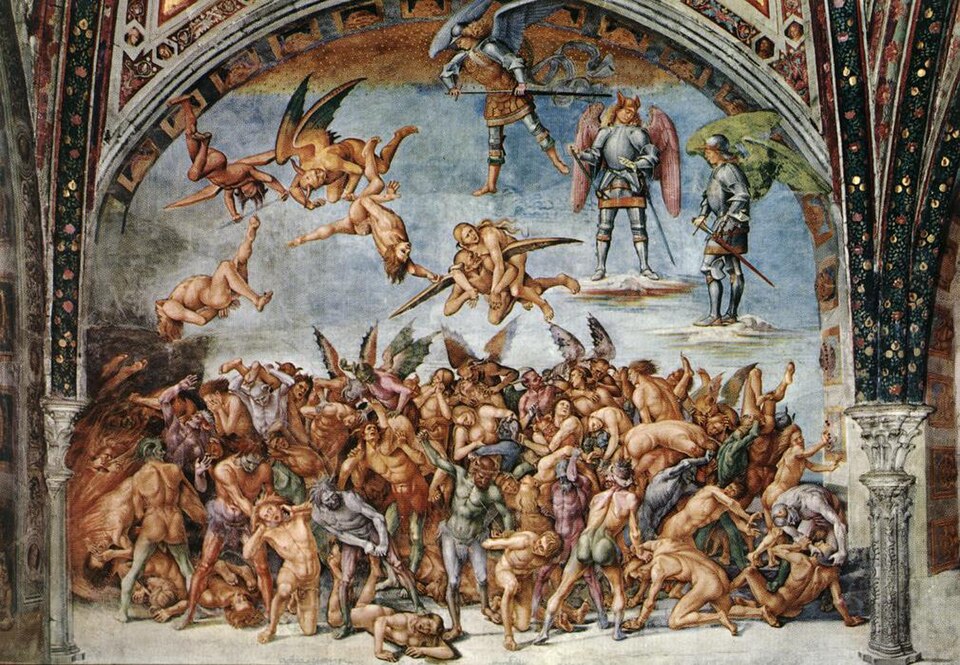
The fresco depicting the souls of sinners, entitled Dannati all’Inferno (The Damned in Hell) (Fig. 6), inspired by Dante Alighieri and classical literature, was created between 1499 and 1502 by the Italian painter Luca Signorelli (1445/50–1523). It is located in the Chapel of St Brizio in Orvieto, Italy.[44], [45]
The French philosopher and mathematician René Descartes (1596–1650) also considered the question of the soul,[46] responding through his theses to the dualistic approach found in metaphysical writings.
In these texts, the body was regarded as distinct from the soul, which was considered a thinking thing. He restricted the mind to its rational aspect alone and took a similar view of the world – in his reflections, he narrowed his perception of it to only that component which could be understood through reason.[47] He likens both humans and animals to machines. According to him, bodily movements arise solely as a consequence of the body’s configuration, and he rejects the notion of a soul that would breathe life into the body, in the sense in which ancient thinkers understood it. To a certain extent, he acknowledges the existence of a soul in humans, but only in the form of the mind. According to him, the mind is governed by subtle moving spirits that control the nervous system, whose action he likens to a breeze.[48] From the mid-seventeenth century to the first third of the twentieth century, his ideas were embraced by proponents of a progressively developing school of thought – Cartesian rationalism – concerned with theological and scientific theories that gradually undermined the stability of contemporary Christian universalism.[49], [50]
The German philosopher Immanuel Kant (1724–1804) also considered this issue,[51] focusing on the experiences individuals undergo through sensory perception. He regarded these as components created by the subject and attributed a spiritual essence to them. He regarded the personality as abstract and extracorporeal.[52]
Friedrich Schelling (1775–1854) also reflected on the soul,[53] arguing that human beings possess not only a material but also a spiritual nature; unlike other philosophers, he regarded the soul, rather than the body, as the source of good and evil. According to him, evil stems from a lack of knowledge and reflection and arises as a result of a disruption of wholeness, which can occur, on the one hand, through a failure to control the instincts and, on the other, through rational decision-making without the involvement of emotions. For him, the foundation of goodness lay in harmony between the emotions and reason – positive values can develop within the soul only through the union of love and wisdom.[54]
The German classical philosopher Georg Wilhelm Friedrich Hegel (1770–1831),[55] like the vitalists, opposed a mechanistic understanding of living beings, yet at the same time distanced himself from a form of vitalism that disregarded the laws of physics.[56] He also understood the soul in a collective sense – as the soul of a cultural community that exists throughout human history, its nature changing in response to the challenges it faces. He described the negative forces that influence it as corruption,[57] thereby, according to the Israeli philosopher Professor Yirmiyahu Yovel (1935–2018),[58] foreshadowing his later theory of self-alienation. In Phenomenology of Spirit, he argues that souls undergo a process of finding themselves.[59]
The English biologist Thomas Henry Huxley (1825–1895)[60] also addressed the subject. In his 1870 essay Has a Frog a Soul? and his 1874 essay On the Hypothesis that Animals are Automata, and its History, he sought to answer questions concerning the souls and consciousness of animals – he attempted to clarify whether their thinking and behaviour are truly merely machine-like. He concluded that neither the existence nor the absence of consciousness in animals can be confirmed, since it is not possible to demonstrate with absolute certainty any consciousness other than one’s own (although it is logically reasonable to assume it in other people). Although, in his view, animals might appear to possess a certain form of consciousness, this is merely a by-product of bodily functioning, without the capacity to alter their actions.[61], [62]
The German philosopher Friedrich Nietzsche (1844–1900)[63] regarded the soul (or mind) and the body as interconnected; he rejected the Socratic identification of reason with happiness and attached greater importance to emotion, irrationality and the body in determining human orientation. He advocated rational decision-making, but only after taking all circumstances into account and with due regard for the sense of the good.[64] He understood rationality as reason in moderation and regarded it as an answer to questions concerning conflicts between instincts and reason.[65]
Source: Wikimedia Commons (Public Domain)
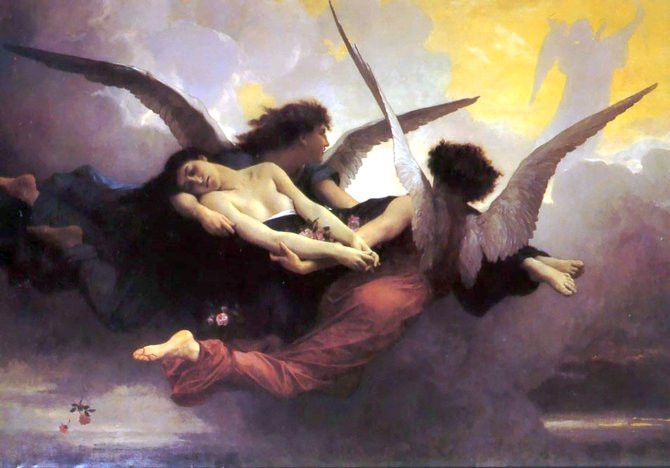
In 1878, the French painter William-Adolphe Bouguereau (1825–1905) depicted a soul carried by angels in his masterpiece Une âme au ciel (A Soul Carried to Heaven) (Fig. 7).[66] The soul is not depicted in an ethereal manner, but as the limp body of a woman; similarly, the angels take human form and are distinguished only by their wings. Nevertheless, thanks to the subtle blurring, the mysterious colour scheme and the billowing clouds, the painting conveys an otherworldly impression.[67]
The Austrian philosopher, social reformer, literary critic, educator and founder of anthroposophy, Rudolf Steiner (1861–1925), sought to bridge science and spirituality while making spiritual matters accessible to a wider audience. His theories were based on spiritual-animistic principles. He was convinced that spiritual beings exist throughout the universe. The legacy of his work is still evident today, for example in the form of Waldorf schools, biodynamic agriculture and anthroposophical medicine.[68], [69], [70], [71], [72]
How did thinking about souls develop later on? How have artists depicted them, and how are they perceived in the major religious systems of the present day? We shall explore these questions in the next instalment.
References
[1]LENCZ, L., Od konfrontácie k dialógu, Križovatky kresťanstva a filozofie, 1992. In PORUBEC, D., O troch typoch filozofie v kontexte európskeho myslenia, 2018, p. 106.[2]KOLEKTÍV, Demokritos a iní grécki atomisti, 1952. In: JAKUBOVSKÁ, V., KOVALCHUK, N., Telo a duša, telo alebo duša : vybrané aspekty v dejinno/filozofickom kontexte, 2017, p. 7.
[3]MYŠIČKA, S., Démokritos o podstatě duše a její smrti, 2015, p. 107.
[4]KOLEKTÍV, Demokritos a iní grécki atomisti, 1952. In: JAKUBOVSKÁ, V., KOVALCHUK, N., Telo a duša, telo alebo duša : vybrané aspekty v dejinno/filozofickom kontexte, 2017, p. 7.
[5]ROJKA, Ľ., Ľudská duša a zážitky blízkej smrti, 2015, p. 6.
[6]Sokrates (469–399 p.n.l.). [online]. [cited 2024–12–18]. Available at: https://encyklopediapoznania.sk/clanok/1443/sokrates–469–399–p–n–l
[7]Dějiny filosofie I : 8. Sókratés. [online]. [cited 2024–12–18]. Available at: https://is.muni.cz/do/rect/el/estud/ff/ps14/phil/web/tisk8.html
[8]NECHUTOVÁ, J., Konsolace od antiky do středověku: genologický pokus, 1991, p. 122.
[9]Duša (Sokrates). [online]. [cited 2024–12–18]. Available at: https://dai.fmph.uniba.sk/~filit/fvd/dusa_sokrates.html
[10]Ibid.
[11]Daimonion (sokrates). [cited 2026–8–8]. Available at: https://dai.fmph.uniba.sk/~filit/fvd/daimonion_sokrates.html
[12]Plato. [online]. [cited 2025–4–16]. Available at: https://plato.stanford.edu/entries/plato/
[13]JAKUBOVSKÁ, V., KOVALCHUK, N., Telo a duša, telo alebo duša : vybrané aspekty v dejinno/filozofickom kontexte, 2017, p. 7.
[14]AMBROZY, M., Niekoľko separovaných prepojení teológie a filozofie, 2016, p. 138.
[15]STANČEK, Ľ., Čnosti, 2005, p. 16.
[16]Radek Chlup. [online]. [cited 2024–12–16]. Available at: https://ufar.ff.cuni.cz/cs/o-ufaru/vyucujici/radek-chlup/
[17]VÍTEK, T., Chlup, Radek : Pojetí duše v náboženských tradicích světa, 2008, p. 140.
[18]ROJKA, Ľ., Ľudská duša a zážitky blízkej smrti, 2015, p. 4.
[19]Ibid., p. 6.
[20]Aristotle. [online]. [cited 2024–12–18]. Available at: https://www.britannica.com/biography/Aristotle
[21]ARISTOTELES, O duši, 1995. In JAKUBOVSKÁ, V., KOVALCHUK, N., Telo a duša, telo alebo duša : vybrané aspekty v dejinno/filozofickom kontexte, 2017, p. 8.
[22]ROJKA, Ľ., Ľudská duša a zážitky blízkej smrti, 2015, p. 6.
[23]JAKUBOVSKÁ, V., KOVALCHUK, N., Telo a duša, telo alebo duša : vybrané aspekty v dejinno/filozofickom kontexte, 2017, p. 8.
[24]JAKUBOVSKÁ, V., KOVALCHUK, N., Telo a duša, telo alebo duša : vybrané aspekty v dejinno/filozofickom kontexte, 2017, p. 8.
[25]ŠROBÁR, Š., Stretnutie stredoveku s Aristotelom, 2018, p. 117.
[26]SPIŠIAKOVÁ, M., Aktuálne problémy s pojmom duše, 2015, p. 33.
[27]Plotinos. [online]. [cited 2024–12–17]. Available at: https://dai.fmph.uniba.sk/~filit/fvp/plotinos.html
[28]KARUL, R., Zvieracia a ľudská duša, čítanie Plotina, 2013, pp. 91–92.
[29]Lekythos. [online]. [cited 2025–5–7]. Available at: https://www.britannica.com/art/lekythos
[30]K11.10 Hermes psychopompus. [online]. [cited 2025–5–6]. Available at: https://www.theoi.com/Gallery/K11.10.html
[31]VOIT, P., Kerykeion. [online]. [cited 2025–5–8]. Available at: https://encyklopedieknihy.cz/index.php/Kerykeion
[32]Svatý chrt. [online]. [cited 2024–12–16]. Available at: https://www.goodreads.com/book/show/18309782–svat–chrt
[33]SCHMITT, J. C., Telo a duše, 1999. In JAKUBOVSKÁ, V., KOVALCHUK, N., Telo a duša, telo alebo duša : vybrané aspekty v dejinno/filozofickom kontexte, 2017, p. 8.
[34]JAKUBOVSKÁ, V., KOVALCHUK, N., Telo a duša, telo alebo duša : vybrané aspekty v dejinno/filozofickom kontexte, 2017, p. 8.
[35]Simone dei Crocifissi. [online]. [cited 2025–5–6]. Available at: https://artuk.org/discover/artists/simone-dei-crocifissi-13301399
[36]LUDIKOVÁ, Z., BURAN, D., Posledný súd, 2013. [online]. [cited 2025–5–6]. Available at: https://www.webumenia.sk/cs/dielo/SVK%3ASNG.O_5478
[37]Platón. [online]. [cited 2024–12–16]. Available at: https://www.jw.org/sk/kniznica/casopisy/g201302/platon-grecky-filozof/
[38]BLUM, P. R., The immortality of the soul : Summary, 2007. In HANKINS, J. (ed.), The Cambridge Companion to Renaissance Philosophy : Cambridge Companions to Philosophy, 2007.
[39]DE CANDIA, G., Theology, Renaissance : Abstract, 2018. In SGARBI, M. (ed.), Encyclopedia of Renaissance Philosophy, 2019, p. 1.
[40]Rogier van der Weyden. [online]. [cited 2025–5–6]. Available at: https://www.artrenewal.org/artists/rogier-van-der-weyden/642
[41]The Beaune Altarpiece (1442–50). [online]. [cited 2025–5–6]. Available at: https://www.wga.hu/tours/flemish/weyden/index.html
[42]GILBERT, E., Michelangelo. [online]. [cited 2025–5–6]. Available at: https://www.britannica.com/biography/Michelangelo
[43]The Last Judgement : Images of a Masterpiece. [online]. [cited 2025–5–6]. Available at: https://www.italian-renaissance-art.com/Last-Judgement.html#gallery%5BpageGallery%5D/4/
[44]NAHUM, P., The Damned Being Plunged into Hell (The Damned Being Cast into Hell) and Dante and Virgil Entering Purgatory, Chapel of San Brizio, Orvieto Cathedral for Souls by the River Styx, 2022. [online]. [cited 2025–5–6]. Available at: https://eb-j.org/browse-artwork-detail/MjE5MjA=
[45]Luca Signorelli. [online]. [cited 2025–5–8]. Available at: https://www.nationalgallery.org.uk/artists/luca-signorelli
[46]René Descartes. [online]. [cited 2024–12–18]. Available at: https://www.britannica.com/biography/Rene-Descartes
[47]FRIDMANOVÁ, M., Alice Kliková : Mimo princip identity : Recenzia, 2008, p. 116.
[48]VODIČKA, V., Co je na životě tak zvláštního? Příklad redukcionismu René Descarta, 2017.
[49]Kartezianizmus. [online]. [cited 2024–12–17]. Available at: https://beliana.sav.sk/heslo/kartezianizmus.
[50]KOPECKÁ, Z., Vladimír Papoušek a kol. : Pokušení neviditelného : Myšlení moderny, 2021, p. 110.
[51]Immanuel Kant. [online]. [cited 2024–12–17]. Available at: https://www.britannica.com/biography/Immanuel-Kant.
[52]JAKUBOVSKÁ, V., KOVALCHUK, N., Telo a duša, telo alebo duša : vybrané aspekty v dejinno/filozofickom kontexte, 2017, p. 11.
[53]DAS, S. B., Friedrich Wilhelm Joseph von Schelling (1775—1854). [online]. [cited 2025–5–9]. Available at: https://iep.utm.edu/schellin/.
[54]DÉMUTH, A., Friedrich Wilhelm Joseph Schelling : Filozofia umenia, 2008. In Filozofia. ISSN 0046-385X, 2008, Vol. 63, No. 7, pp. 648–651.
[55]Hegel, Georg Wilhelm Friedrich. [online]. [cited 2024–12–17]. Available at: https://beliana.sav.sk/heslo/hegel-georg-wilhelm-friedrich.
[56]TOBIÁŠ, F., Hegel o dialektike živej prírody, 1977, p. 666.
[57]Ibid., p. 666.
[58]Yirmiyahu Yovel. [online]. [cited 2024–12–16]. Available at: https://akadem.org/author/yirmiyahu-yovel.
[59]YOVEL, Y., Mladý Hegel a duch judaizmu : (2. časť), 2012.
[60]Thomas Henry Huxley. [online]. [cited 2024–12–17]. Available at: https://www.britannica.com/biography/Thomas-Henry-Huxley.
[61]HUXLEY, T. H., On the Hypothesis that Animals are Automata, and its History, 1874. In ROJKA, Ľ., Sebapotvrdenie a sebakritickosť človeka, 2016, p. 30.
[62]HUXLEY, T. H., Has a frog soul?, 1870. [online]. [cited 2025–4–21]. Available at: http://aleph0.clarku.edu/huxley/Mss/FROG.html.
[63]Friedrich Nietzsche. [online]. [cited 2024–12–16]. Available at: https://www.britannica.com/biography/Friedrich-Nietzsche.
[64]NIETZSCHE, F., O živote a umění, 1995. In JAKUBOVSKÁ, V., KOVALCHUK, N., Telo a duša, telo alebo duša : vybrané aspekty v dejinno/filozofickom kontexte, 2017, p. 11.
[65]NIETZSCHE, F., Soumrak model, 1995. In JUSKO, Š., Sokratovská otázka ako filozofický problém, 2018, p. 185.
[66]A Soul Brought to Heaven 1878. [online]. [cited 2025–5–7]. Available at: https://bouguereau.org/.
[67]Soul Carried to Heaven. [online]. [cited 2025–5–7]. Available at: https://www.wikiart.org/en/william-adolphe-bouguereau/soul-carried-to-heaven.
[68]Rudolf Steiner. [online]. [cited 2025–5–14]. Available at: https://www.antropozofia.sk/?page_id=112.
[69]Rudolf Steiner – tvorca antroposofie. [online]. [cited 2025–5–14]. Available at: https://www.antroposof.sk/dalsie_temy/rudolf_steiner.html.
[70]STEINER, R. 1912. Duchovné bytosti v kozmických telesách a prírodných ríšach : Desať prednášok konaných v Helsigforse v čase od 3. do 14.apríla 1912. [online]. [cited 2025–5–14]. Available at: https://sophia.sk/sites/default/files/Steiner_Duchovne_bytosti_v_nebeskych_telesach_nahlad.pdf.
[71]PRESUTTI, F., The Discipline “PsychoSophy” of the 21t century : Abstact, 2025.
[72]Rudolf Steiner. [online]. [cited 2025–5–14]. Available at: https://antroposofickamedicina.cz/rudolf-steiner.
The complete bibliographic references for these sources can be found here.