


In the first part of the article, our exploration of theories of the soul brought us to the nineteenth century, and today we shall continue.
In 1871, a book entitled Primitive Culture by the prominent English anthropologist Sir Edward Burnett Tylor (1832–1917)[1], regarded as the founder of cultural anthropology, was published. The work had a significant influence on the subsequent development of anthropology, religious studies and other related disciplines.[2], [3]
According to Tylor, the theory of the soul is one of the most important subjects of the philosophy of religion.[4] In the book, he primarily presents his research into animism – he examines the relationships between the soul, spirits, animate and inanimate nature, and objects created by human beings as well as the way these relationships were perceived by prehistoric people and members of indigenous peoples. In their ways of thinking, he sought traces of earlier manifestations of thought. According to him, animism constitutes the foundation of the philosophy of religion.[5]
Source: Wikimedia Commons (Public Domain)
The writings of Edward B. Tylor and other nineteenth-century anthropological scholars, together with the availability of objects originating from colonial expeditions and displayed in museums, also influenced the visual arts – contributing to the development of the movement known as primitivism. The works of its representatives were inspired by the aesthetics, life, philosophy and cultural practices of non-European peoples.[6], [7]
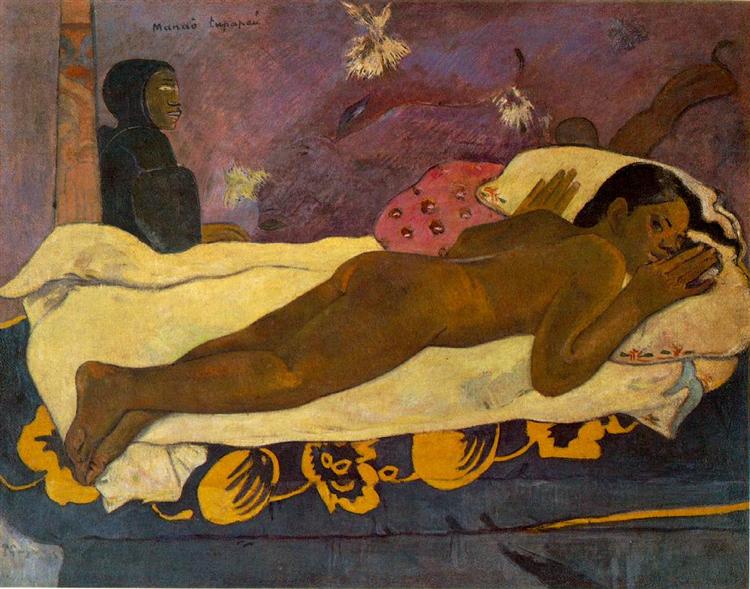
An example is the painting Manaò tupapaú (The Spirit of the Dead Watching) (Fig. 1), created in 1892 by the French painter, sculptor, printmaker, ceramicist and writer Paul Gauguin (1848–1903).[8]
Animism has survived to the present day as a natural part of the cultures of peoples whose lives are closely connected with nature. It has also re-emerged in academic circles, where it has acquired the qualifier new, while scholars working with the concept distance themselves from Victorian animism because of its evolutionist approach.[9] According to the English social anthropologist Katherine Swancutt,[10], [11] animism, although its suffix might suggest otherwise, is not an ideology. Rather, it is a more sensitive response to the world around us and the beings that inhabit it. People with an animistic sensibility regard not only humans and animals as beings with souls, but also plants, bodies of water, wind, the moon, stones and even machines.[12]
The art of non-European peoples also plays a key role in the work of the contemporary Australian Aboriginal artist Otis Hope Carey (1988) – in his paintings and sculptures, he combines traditional sources of inspiration with contemporary artistic means. Through the depiction of legends and symbols, he seeks to bring together communities from different cultures. He also explores themes of healing, the transmission of knowledge and the connection with nature, culture and rituals.[13] An example of his work is Yaam ngaya ngaarlu (I Am Water), created in 2024.
In the nineteenth century, so-called spiritism became popular. It originated in France and spread throughout the world. It is an occult religion whose practices include so-called spiritualist séances. During these séances, contact with the spirit world is allegedly established, accompanied by supernatural phenomena.[14], [15]
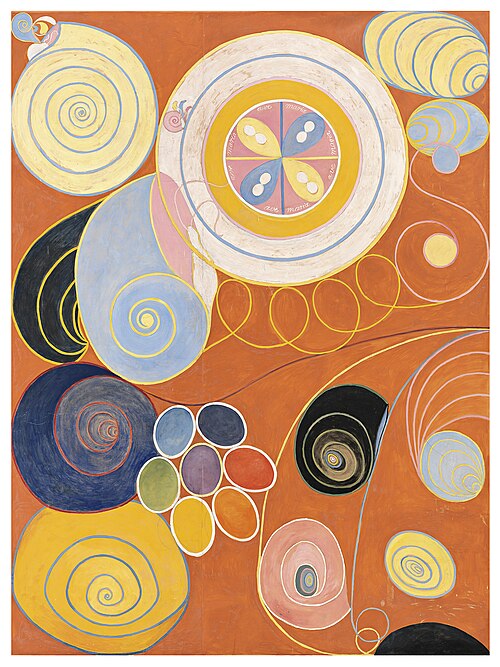
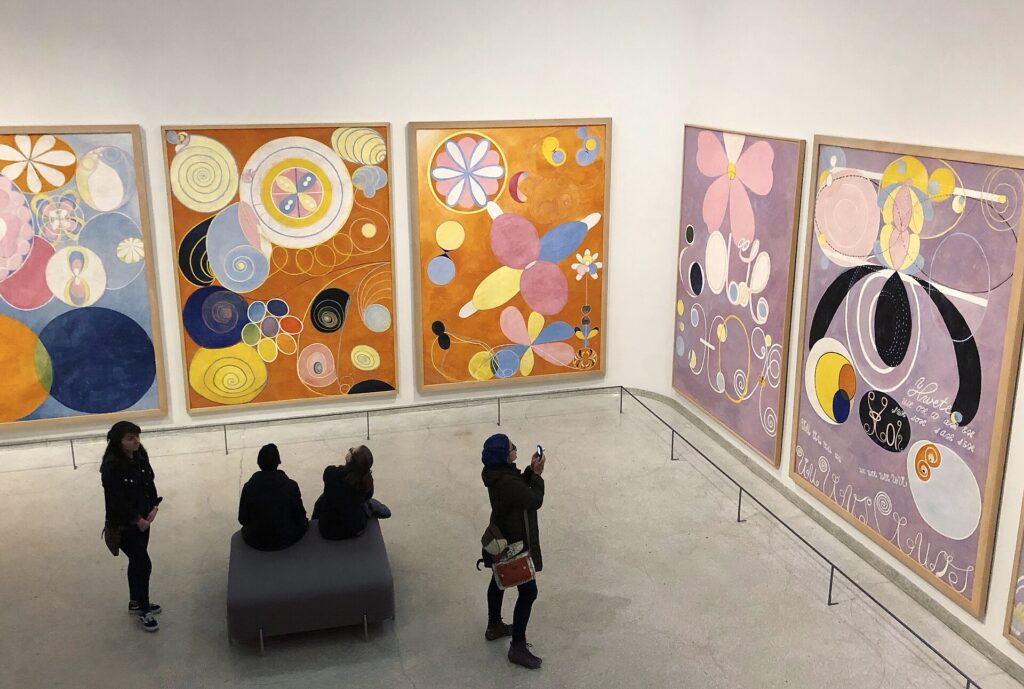
The work of the Swedish artist Hilma af Klint (1862–1944) is also connected with Spiritism. She drew inspiration for her visionary works precisely during spiritualist séances – instructions for her paintings came to her through automatic writing and drawing. She created abstract works before Wassily Kandinsky, Kazimir Malevich and Piet Mondrian.[16] An example of her work is The Ten Largest, No. 3, Youth, Group IV from 1907 (Fig. 2). A view of the exhibition of her works entitled Paintings for the Future, which was held at the Guggenheim Museum in New York in 2018, can be seen in Fig. 3.
Fig. 2: Hilma af Klint, The Ten Largest, No. 3, Youth, Group IV, tempera on paper mounted on canvas, 321 × 240 cm, 1907
Source: Albin Dahlström / Wikimedia Commons (Public Domain)
Source: Ryan Dickey / Wikimedia Commons (CC BY 2.0)
In examining the subject, we cannot overlook the world’s religions. We have briefly considered the concept of the soul in Christianity; in the following paragraphs, we shall also outline the teachings of other major religious systems.
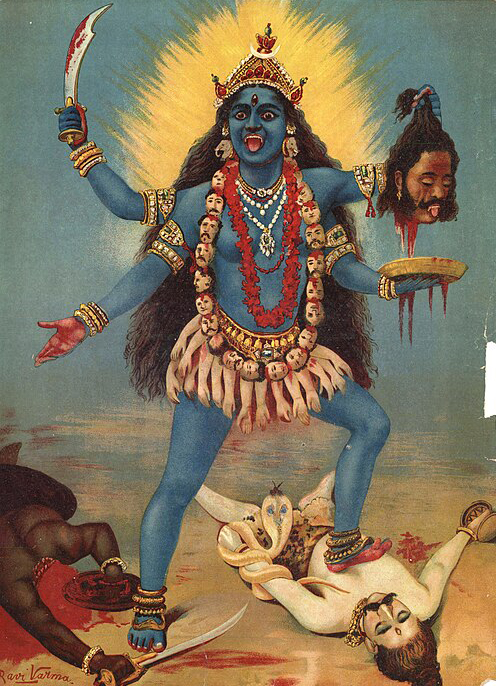
Hindus believe in reincarnation, in which souls are reborn and continue to live after the death of the temporary body, while striving to attain the state of moksha, representing liberation from the cycle of reincarnation known as samsara. The body into which a person is reborn depends on their karma, determined by actions and utterances that are either in accordance with or contrary to the rules known as dharma. A person’s subsequent rebirth will be their reward or punishment.[17], [18] Fig. 4 depicts Kali, who in Hinduism is the goddess of rebirth, death and time. The painting is by the Indian artist Raja Ravi Varma (1848–1906).[19]
Source: Wikimedia Commons (Public Domain)
Source: Wikimedia Commons (Public Domain)
According to the Buddha’s teachings, life is full of suffering, which arises from dissatisfaction resulting from unfulfilled desires. However, it can be eliminated by overcoming ignorance. The Buddha rejected the concept of the soul as an immortal entity and understood life as a process through which an individual undergoes self-development. According to him, material possessions, status, relationships and even the mind are not the true self. According to Buddhists, human existence consists of five aggregates: corporeality, emotions and perceptions, concepts, mental dispositions and consciousness; none of these, however, constitutes an unchanging self.[20]
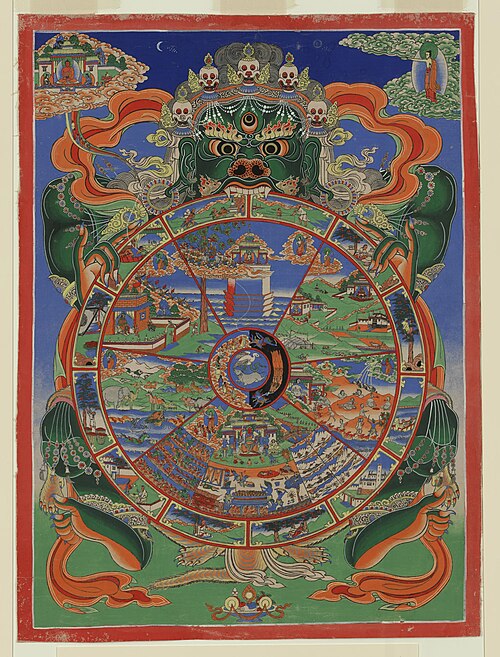
The mind contributes to perception and is constantly changing, and therefore passes through various states.[21] Like Hindus, Buddhists believe in karma and rebirth, but do not recognise the immortality of the soul.[22] Fig. 5 shows the wheel of rebirth (life, existence, reincarnation), Bhavachakra, representing a circular symbol of the infinity of existence used primarily in Tibetan Buddhism.[23], [24]
In Judaism, there is a belief that after death the soul leaves the body. According to an old custom, mirrors are then covered in the house and a window is also opened so that the soul can fly out. Mirrors are concealed because, during the period of mourning, various kinds of demons and evil spirits are believed to enter the house in which a family member has died.[25] According to the Australian rabbi Aron Moss,[26], [27] however, this custom could also be explained psychologically – death is accompanied by a feeling of emptiness that could be filled by inner demons. In addition to grief, we may also feel anger, regret or guilt, and in this way the bereaved do not have to confront the reflections of their own faces, into which these emotions are inscribed.[28] The subject was addressed, for example, by the artist Helène Aylon in her 1987 installation Mirror Covering.[29]
Among other things, the difference between Judaism and Christianity lies in the fact that Jews do not regard asceticism as a means of strengthening the spirit. Body and soul are considered unified in Jewish belief, and both are even held equally responsible for sin.[30] Jewish religion attaches great importance to the teaching of Kabbalah, which, in view of the complex history of Israel and the Jewish people and their role in history, attributes special qualities to Jewish souls. Kabbalists believe that the soul consists of three layers – the first is the basic one, which, similarly to Aristotle, they believe contains three powers: rational, animal and vegetative.[31]
Islam deals extensively with the issue of death and the afterlife in order to help believers come to terms with this difficult subject. Muslims believe in the immortality of the soul. After death, it leaves the body, which was created from earth, is buried in it and ultimately rises from it.[32] The similarity with Christian and Jewish interpretations stems from their shared geographical location – their cradle is the Middle East. In Islam, death is compared to a bridge between our world and another.[33] Death is preceded by a summons from the Angel of Death, who is assigned to the soul, and on the first night after the body is buried, a preliminary judgement takes place, conducted by the angels Nakir and Munkar. The soul must correctly answer questions about whether it knows God, the Holy Book and the Prophet – in the case of affirmative answers, the body will await resurrection in a spacious grave; otherwise, it will be placed in a small and dark grave.[34]
The installation Wave Catcher by the Saudi Arabian artist, scientist, curator and designer Basmah Felemban (1993)[35] represents the adhan – the public call to prayer transformed into 16 wooden wave catchers, which metaphorically capture the breath exhaled between the individual parts of the prayer. Islamic prayers can be compared to waves because of their phrasing and use of pitch.[36], [37] The work was part of the Islamic Arts Biennale: Mirroring the Journey of the Soul, which took place in 2023.[38], [39] The fact that the soul is connected with breath is also reflected in verse 15:29 of the Qur’an.[40]
We have briefly outlined the perception of the soul within the context of the world’s religions. But what is the relationship of atheists to souls? According to the Czech philosopher and political scientist Jan Werner,[41], [42] they may nevertheless believe in souls, horoscopes or life after death, since atheism, in essence, consists merely in not believing in the existence of God. New atheism, however, is a kind of extension of atheism in general, and people who identify with it reject these beliefs as well.[43] Richard Dawkins (1941), a British biologist, ethologist and writer,[44] argues that atheists who adhere to a naturalistic worldview do not believe in the existence of anything that transcends the physical world, nor in a higher power, creative intelligence, immortal souls or miracles. They explain everything through the effects of natural phenomena that science has not yet explained.[45]
Active believers who attend religious services every week, as well as atheists, do not, however, constitute the majority of the population. Spirituality could rather be understood as a spectrum, with the majority of people situated somewhere between these two groups.[46], [47] The sociologist of religion Thomas Luckmann (1927–2016)[48] referred to this phenomenon as so-called invisible religion – according to him, active church religiosity is merely one form of modern religiosity.[49] The American priest and scholar of religion Edward Ian Bailey (1935–2015)[50] spoke in this context of implicit religion,[51] while the Dutch scholar of religion, historian of religion and Islamologist Professor Jacques Waardenburg (1930–2015)[52] also regarded ideologies as implicit religions.[53]
Within esoteric traditions, souls feature prominently. The most frequently mentioned are soulmates, whom an individual recognises on the basis of encounters from past lives; these may involve romantic, family or friendship relationships, or relationships with animals.[54] Within esoteric teachings, we also encounter karmic relationships and twin-flame relationships. The controversial discourse surrounding the connections between the soul, the afterlife, consciousness and quantum mechanics raises questions concerning the boundaries between science and esotericism.[55] However, according to Sean Michael Carroll (1966), an American professor of theoretical physics and philosopher,[56] quantum physicists no longer consider the influence of consciousness in the sense invoked by esotericists within their field, which nevertheless does not prevent esoteric gurus from continuing to refer to science, misinterpreting its concepts and disseminating them among the general public with considerable success and profit.[57]
With the development of science, the range of disciplines analysing this issue expanded, and in some contexts the concept of the soul began to be replaced by the terms of consciousness and the unconscious, but we will explore these on another occasion.
Our exploration of the history of conceptions of the soul concludes with the lithograph Inside the Soul by the contemporary Japanese visual artist Takashi Murakami (1962).[58] The artist draws on traditional Japanese aesthetics, which he combines with the legacy of pop art and the lifestyle of otaku (a youth culture fascinated by anime, toys and video games). Murakami developed superflat aestethic, which subsequently evolved into a movement. It combines high art with mass culture and is characterised by playfulness and vivid colours,[59] while at the same time drawing attention to the flatness of contemporary consumer-oriented society, thereby creating an interesting contrast.[60]
His artworks, although they appear joyful, conceal serious messages – they are a critique of war, gender stereotypes and the superficiality of the age. Murakami’s flowers – his most characteristic symbol – appear cheerful at first glance, but as we learn more about the subjects he addresses, we perceive their sadness and emptiness, as well as their potential to inspire people to introspection.[61]
‘I believe that art can change the world.‘
Takashi Murakami[62]
References
[1] Sir Edward Burnett Tylor. [online]. [cited 2024–12–17] Available at: https://www.britannica.com/biography/Edward-Burnett-Tylor
[2] Ibid.
[3] TYLOR, E. B., Primitive culture : Volume I., 1888.
[4] TYLOR, E. B., Primitive culture : Volume I., 1888, p. 501, 502.
[5] SWANCUTT, K.., Animism, 2019. In STEIN, F. (ed.)., Open Encyclopedia of Anthropology : Facsimile of the first edition in The Cambridge Encyclopedia of Anthropology, 2019, p. 5.
[6] CRAMER, CH., GRANT, K. 2020. Primitivism and Modern Art. [online]. [cited 2025–5–6] Available at: https://smarthistory.org/primitivism-and-modern-art/
[7] Primitivism. [online]. [cited 2024–12–18] Available at: https://www.theartstory.org/movement/primitivism/
[8] Paul Gauguin and his paintings. [online]. [cited 2025–5–6] Available at: https://www.gauguin.org/
[9] WILKINSON, D. A., Is There Such a Thing as Animism?, 2017, p. 289, 292.
[10] Dr Katherine Swancutt. [online]. [cited 2024–12–16] Available at: https://www.kcl.ac.uk/people/katherine-swancutt
[11] Her date of birth is not publicly available.
[12] SWANCUTT, K.., Animism, 2019. In STEIN, F. (ed.)., Open Encyclopedia of Anthropology : Facsimile of the first edition in The Cambridge Encyclopedia of Anthropology, 2019, p. 1.
[13] KAMIYA, A. Spiritism History, Beliefs & Practices. [online]. [cited 2025-5-15] Available at: https://study.com/academy/lesson/spiritism-overview-beliefs-facts.html
[14] ŠIMALČÍK, J., Spiritizmus (duchárstvo) vo svetle celej pravdy, 1932, p. 5.
[15] About the artist Hilma af Klint. [online]. [cited 2025-5-8] Available at: https://www.modernamuseet.se/stockholm/en/exhibitions/hilma-af-klint-2013/about-the-artist/
[16] Otis Hope Carey. [online]. [cited 2025–5–8] Available at: https://4a.com.au/creatives/otis-hope-carey
[17] HURAJTOVÁ, J. Hinduizmus : Pomôcka pre ZŠ a SŠ, 2014.
[18] Hinduizmus. [online]. [cited 2024–11–9] Available at: https://beliana.sav.sk/heslo/hinduizmus
[19] BENTLEY–HENSON, A. 2023. Hindu Goddess Kali | History, Mythology & Symbol. [online]. [cited 2025–5–6] Available at: https://study.com/academy/lesson/the-hindu-goddess-kali-story-symbols-facts.html
[20] NAKAMURA, H., REYNOLDS, F. E., TUCCI, G., Buddhism, 2025. [online]. [cited 2024–12–18] Available at: https://www.britannica.com/topic/Buddhism/The-life-of-the-Buddha
[21] MILTNER, V., Mistr Šankara kontra buddhismus, 1996, p. 68, 69.
[22] MAHĀSI SAYĀDAW, The Theory of Karma. [online]. [cited 2025–5–8] Available at: https://www.buddhanet.net/e-learning/karma/
[23] File:Bhavachakra.jpg. [online]. [cited 2025–5–8] Available at: https://commons.wikimedia.org/wiki/File:Bhavachakra.jpg

[24] Bkhavachakra – Koleso Bytiya. [online]. [cited 2025–5–8] Available at: https://probud.narod.ru/symbol/bhavachakra.html
[25] PAŘÍK, A., HAMÁČKOVÁ, V., Pražské židovské hřbitovy, 2003. In: ŠVEDOVÁ, M., Židovské cintoríny vo vybraných mestách severovýchodného Slovenska a ich význam pre turizmus, 2018, p. 30.
[26] Aron Moss. [online]. [cited 2024–11–9] Available at: https://www.chabad.org/search/keyword_cdo/kid/8051/jewish/Aron-Moss.htm
[27] His date of birth is not publicly available.
[28] MOSS, A., Why Are the Mirrors Covered in a House of Mourning? [online]. [cited 2024–11–8] Available at: https://www.chabad.org/library/article_cdo/aid/2969340/jewish/Why-Are-the-Mirrors-Covered-in-a-House-of-Mourning.htm
[29] Helène Aylon : Reflections. [online]. [cited 2025–5–7] Available at: https://www.mutualart.com/Exhibition/Helene-Aylon–Reflections/7C7CBD1868E2BA87
[30] SLIVKA, D. et al., Židovská kultúra v multikultúrnej edukácii : Základné východisko eliminácie neznášanlivosti a xenofóbie v kontexte celoživotného vzdelávania pracovníkov základných a stredných škôl s prílohou didaktických materiálov, 2013, p. 87.
[31] DROZDÍKOVÁ, J., Základy judaizmu, 1993. In SLIVKA, D. et al., Židovská kultúra v multikultúrnej edukácii. Základné východisko eliminácie neznášanlivosti a xenofóbie v kontexte celoživotného vzdelávania pracovníkov základných a stredných škôl s prílohou didaktických materiálov, 2013, p. 85.
[32] AL–ABSI, M., Islamský pohľad na fenomén smrti a jeho reflexia v systéme pohrebných obradov a rituálov, 2008, pp. 15–21.
[33] AL–ABSI, M., Islamský pohľad na fenomén smrti a jeho reflexia v systéme pohrebných obradov a rituálov, 2008, pp. 15-21.
[34] Ibid., pp. 15-21.
[35] Basmah Felemban. [online]. [cited 2025–5–8] Available at: https://riyadhart.sa/en/artists/basmah-felemban/
[36] Islamic Arts Biennale : Mirroring the journey of the soul. 2023. [online]. [cited 2025–5–6] Available at: https://www.trtworld.com/magazine/islamic-arts-biennale-mirroring-the-journey-of-the-soul-64792
[37] Basmah Felemban : Saudi, b. 1993. [online]. [cited 2025–5–6] Available at: https://athrart.com/artists/42-basmah-felemban/works/9344-basmah-felemban-wave-catcher-2023/
[38] Islamic Arts Biennale : Mirroring the journey of the soul. 2023. [online]. [cited 2025–5–6] Available at: https://www.trtworld.com/magazine/islamic-arts-biennale-mirroring-the-journey-of-the-soul-64792
[39] Basmah Felemban : Saudi, b. 1993. [online]. [cited 2025–5–6] Available at: https://athrart.com/artists/42-basmah-felemban/works/9344-basmah-felemban-wave-catcher-2023/
[40] In English*: “And when I have proportioned him and breathed into him of My [created] soul, then fall down to him in prostration.” Translation: Zuzana Dolinay. In 15:29. [online]. [cited 2025–5–6] Available at: https://legacy.quran.com/15/29
[41] KŘÍŽ, J., Populismus nesmí zastínit racionální kritiku islámu, říká ateista Werner, 2017. [online]. [cited 2024–11–12] Available at: https://avokado-online.cz/populismus-nesmi-zastinit-racionalni-kritiku-islamu-rika-ateista-werner/
[42] His date of birth is not publicly available.
[43] PARADA, J., Existujú ateisti, ktorí veria v nadprirodzené javy, 2022. [online]. [cited 2024–11–12] Available at: https://www.humanisti.sk/2022/11/12/existuju-ateisti-ktori-veria-v-nadprirodzene-javy/
[44] Richard Dawkins. [online]. [cited 2024–11–13] Available at: https://www.britannica.com/biography/Richard-Dawkins
[45] DAWKINS, R., Boží blud, 2016. In KEČKA, R., Súčasná kritika náboženstva – Nový ateizmus ako tvrdý ateizmus, 2017, pp. 2–13.
[46] NEŠPOR, Z., Český spirituální trh jako předmět religionistického výzkumu, 2009, p. 7.
[47] Prieskum Focusu : Aspoň raz za týždeň chodí do kostola štvrtina Slovákov, najviac voliči KDH, 2022. [online]. [cited 2024–11–15] Available at: https://svetkrestanstva.postoj.sk/118388/aspon-raz-za-tyzden-ide-do-kostola-27-percent-ludi
[48] Thomas Luckmann (14 October 1927 – 10 May 2016). [online]. [cited 2025–1–18] Available at: https://www.kim.uni-konstanz.de/en/social-science-archive-konstanz/archive-inventory/archive-inventory-a-m-1/thomas-luckmann/
[49] LUCKMANN, T., The Invisible Religion : The Problem of Religion in Modern Society, 1967. In NEŠPOR, Z., Český spirituální trh jako předmět religionistického výzkumu, 2009, p. 7.
[50] HUGHES, P., Edward Bailey and Implicit Religion, 2015.
[51] BAILEY, E., Implicit Religion in Contemporary Society, 1997. In NEŠPOR, Z., Český spirituální trh jako předmět religionistického výzkumu, 2009, p. 8.
[52] Jacques Waardenburg : Životopis. [online]. [cited 2024–11–15] Available at: https://www.databazeknih.cz/zivotopis/jacques-waardenburg-46588
[53] WAARDENBURG, J., Bohové zblízka : Systematický úvod do religionistiky, 1997, p. 128, 129.
[54] STOKKE, CH., Exploring the transpersonal phenomena of spiritual love relations : A naturalistic observation study of soulmate experiences shared in a New Age Facebook group : Abstract, 2021.
[55] DEL MEDICO, B., Za koncom : Vedecké hypotézy o nesmrteľnosti : Od duše ku kvantovému vedomiu, 2024, p. 13.
[56] Sean Carroll. [online]. [cited 2024–11–14] Available at: https://philosophy.jhu.edu/directory/sean-carroll/
[57] VALENT, D., Ezoterici sú celkom mimo : Znásilňovanie kvantovej mechaniky, 2017. [online]. [cited 2024–11–14] Available at: https://invivomagazin.sk/ezoterici-su-celkom-mimo-znasilnovanie-kvantovej-mechaniky_635.html
[58] Takashi Murakami. [online]. [cited 2025–5–8] Available at: https://www.artsy.net/artist/takashi-murakami
[59] Inside the Soul. [online]. [cited 2025–5–7] Available at: https://www.riseart.com/art/151057/inside-the-soul-by-takashi murakami?srsltid=AfmBOop8EkXSV8VkZMLTaAfNrE9qEs3FEQXWnmlHzqkO1Fw2uDIRcy–
[60] Superflat. [online]. [cited 2025–5–7] Available at: https://www.theartstory.org/movement/superflat/
[61] Takashi Murakami. [online]. [cited 2025–5–8] Available at: https://www.thebroad.org/art/takashi-murakami
[62] In English*: “I believe that art can change the world (jap. „「芸術は世界を変えることができると信じています。」“).” Translation: Zuzana Dolinay. In 30 Best Takashi Murakami Quotes With Image. [online]. [cited 2025–5–8] Available at: https://www.bookey.app/quote-author/takashi-murakami